Disclosure: This post may contain affiliate links, meaning if you decide to make a purchase through my links I may earn a commission at no additional cost to you. See my disclosure for more info.
Finding the best prebiotic fiber supplement is key to supporting your health goals. Are you aiming for better digestive regularity? Looking for a tool to help with weight management? Trying to boost your athletic recovery? There is no single “best” for everyone. The right choice for you will be a high-quality product. It should have scientifically-backed fibers like inulin, FOS, or acacia gum. It must directly support your personal goals.
Supplement note: This guide is for educational purposes only and is not medical advice. Always speak with your doctor before using supplements, especially if you are pregnant, nursing, taking medication, or managing a medical condition.
Continue researching Best Prebiotic Fiber Supplement with our collection of digestive wellness resources.
This guide will walk you through how to pick a supplement. It will be a perfect match for your body and your objectives.
Explore related digestion, gut health and daily wellness guides designed for active lifestyles.
Understanding Prebiotics and Your Gut Health
Prebiotic fiber supplements are food for the good bacteria in your gut. Think of your gut as a garden. Prebiotics are the high-quality fertilizer that helps beneficial microbes thrive. This, in turn, boosts your overall health. This is different from probiotics. Probiotics are live bacteria you introduce into your system. Prebiotics work by nourishing the friendly bacteria you already have.

As your gut bacteria feast on these fibers, they produce powerful compounds. These are called short-chain fatty acids (SCFAs). These little powerhouses are critical for keeping your colon lining healthy. They also tame inflammation. They can even help regulate your immune system.
More NutritionGeeks Wellness Guides
Explore more NutritionGeeks guides connected to wellness, recovery, hydration, energy, sleep and active lifestyle nutrition.
Why Your Microbiome Matters
Your gut is home to a massive community of trillions of microorganisms. This is known as your microbiome. When this community is balanced and diverse, the benefits ripple throughout your entire body.
A healthy microbiome is linked to:
- Better Digestive Function: This often means more regular, comfortable bowel movements. It also means less bloating or gas.
- Improved Nutrient Absorption: Good bacteria help break down food parts your body cannot. This unlocks more essential vitamins and minerals for you to use.
- A Stronger Immune System: A huge chunk of your immune system is in your gut. A well-nourished microbiome is key to its proper function.
- Weight Management Support: Some prebiotic fibers help you feel fuller for longer. They can assist in appetite regulation. This makes them a useful partner in reaching weight loss goals.
It’s no surprise that the demand for these supplements is exploding. The global prebiotic fiber market is set to grow. It will go from USD 7.1 billion in 2025 to USD 13.1 billion by 2035. This growth gives you more options than ever. But it also means you need to be more discerning when you choose.
Common Types of Prebiotic Fiber
Not all prebiotic fibers are created equal. They each have slightly different properties. Some ferment very quickly in the gut. This can be great for your microbes. But it might cause a bit of gas for sensitive individuals. Others are digested more slowly and are typically much gentler.
Common types you’ll see include inulin and fructooligosaccharides (FOS). Galactooligosaccharides (GOS) and resistant starch are also common. Psyllium husk is another popular fiber. It provides some prebiotic effects, too. Our guide on how to consume psyllium husk is a great place to start.
For a deeper dive, this comprehensive nutrition library is an excellent resource. The more you understand the fundamentals, the easier it will be to choose a supplement. This will help you on your health journey.
Understanding Different Types of Prebiotic Fibers
Not all prebiotics work the same way in your gut. Think of them as specialized fertilizers for your internal garden. Some provide a quick burst of nourishment. Others offer a slow, steady release. Getting to know the most common prebiotic fibers will show you something. Their unique actions translate into different benefits.
Knowing these distinctions is the key to picking the right supplement. This is true whether your goal is better digestive comfort or enhanced metabolic health.
Inulin and Fructooligosaccharides (FOS)
Inulin and Fructooligosaccharides (FOS) are probably the most well-known prebiotics. You’ll find them naturally in foods like chicory root, garlic, and bananas. Their claim to fame is that they ferment very quickly. This happens once they reach your colon.
This rapid fermentation provides a feast for beneficial bacteria. This is especially true for Bifidobacteria. Studies have shown that a consistent intake of inulin and FOS can boost these microbes. They play a big role in strengthening the gut barrier. They also support immune function.
As a bonus, they’re also known to help with calcium absorption. This gives you a two-for-one benefit for both gut and bone health.
Because they ferment so fast, inulin and FOS can sometimes cause gas or bloating. This is especially true for sensitive people or at higher doses. It’s always a good idea to start with a small amount. Slowly work your way up to give your system time to adjust.
Galactooligosaccharides (GOS)
If you’re looking for a gentler option, Galactooligosaccharides (GOS) are often the way to go. Derived from lactose (milk sugar), GOS is typically very well-tolerated. Even people who struggle with other fibers can handle it.
Just like FOS, GOS is fantastic at feeding Bifidobacteria. But it tends to ferment at a slightly slower rate. This means you get the benefits with less risk of gas and bloating. This makes it a perfect starting point for newcomers. It is also great for those with conditions like IBS. Its gentle action is why it’s often added to infant formulas. It helps build a healthy gut from the very beginning.
Resistant Starch
Resistant starch is a fascinating type of fiber. It literally “resists” digestion in the small intestine. It travels all the way to the large intestine before it begins to ferment. Even then, it does so very slowly. It’s found in foods like green bananas, legumes, and even cooked and cooled potatoes.
This slow fermentation process is a powerhouse for producing butyrate. Butyrate is a critical short-chain fatty acid. It is the main fuel source for the cells lining your colon. This helps to keep your gut wall strong and healthy.
Resistant starch is often the top choice for anyone focused on metabolic health. This is thanks to its role in producing butyrate and its minimal side effects.
Acacia Fiber and Other Gentle Options
For anyone who needs the absolute mildest prebiotic, acacia fiber is a clear winner. Also called acacia gum, this soluble fiber comes from the sap of the Acacia tree. It is famous for its incredibly slow fermentation rate.
- Acacia Fiber: This one is exceptionally well-tolerated. It also dissolves easily in liquids. It does not get thick or gritty. This makes it effortless to add to your daily routine.
- Xylooligosaccharides (XOS): Found in things like bamboo and corn cobs, XOS is potent stuff. It’s been shown to boost Bifidobacteria even at tiny doses. Often just one or two grams a day is enough.
These fibers are excellent picks if you want to support your gut health. You can do so without worrying about digestive upset. As you explore what works for you, you might want to look into other supplements. We’ve done a breakdown of Herbalife fibre products, for example.
Industry analysis confirms that FOS, GOS, and acacia are popular prebiotics. We’re also seeing more “synbiotic” formulas. These combine prebiotics with probiotics for a more powerful effect. You can learn more about prebiotic market trends on cognitivemarketresearch.com.
A Detailed Comparison of Top Prebiotic Supplements
Finding the right prebiotic fiber supplement isn’t about picking the one with the flashiest label. It’s about matching the right tool to the right job. I’m going to break down how to choose the best option for your specific goals. This applies whether you’re trying to manage your weight or fuel your next run.
We’ll cut through the noise by looking at what really matters. This includes the type and purity of the fiber. It also includes the dose in each serving. We will also consider whether a powder or capsule makes more sense for your lifestyle.
(Disclosure: Please note that this section may contain affiliate links. If you make a purchase through these links, we may earn a commission at no extra cost to you. We only recommend products we trust and believe will provide value.)
Fiber Type And Purity
The type of fiber you choose is the most critical decision. Someone with an iron gut might want to quickly boost their Bifidobacteria. They might do great with an aggressive fiber like inulin. A solid 5-gram dose of pure chicory root inulin can give your microbiome a kickstart.
But what about a runner who can’t risk digestive upset mid-marathon? Or anyone just dipping their toes into prebiotics? In that case, a gentler, slow-fermenting option like acacia fiber is smarter. Purity is also key here. You want supplements that are 100% pure fiber. You do not want something loaded with fillers or artificial sweeteners.
This flowchart can help you visualize which fiber type aligns best with your wellness goals.
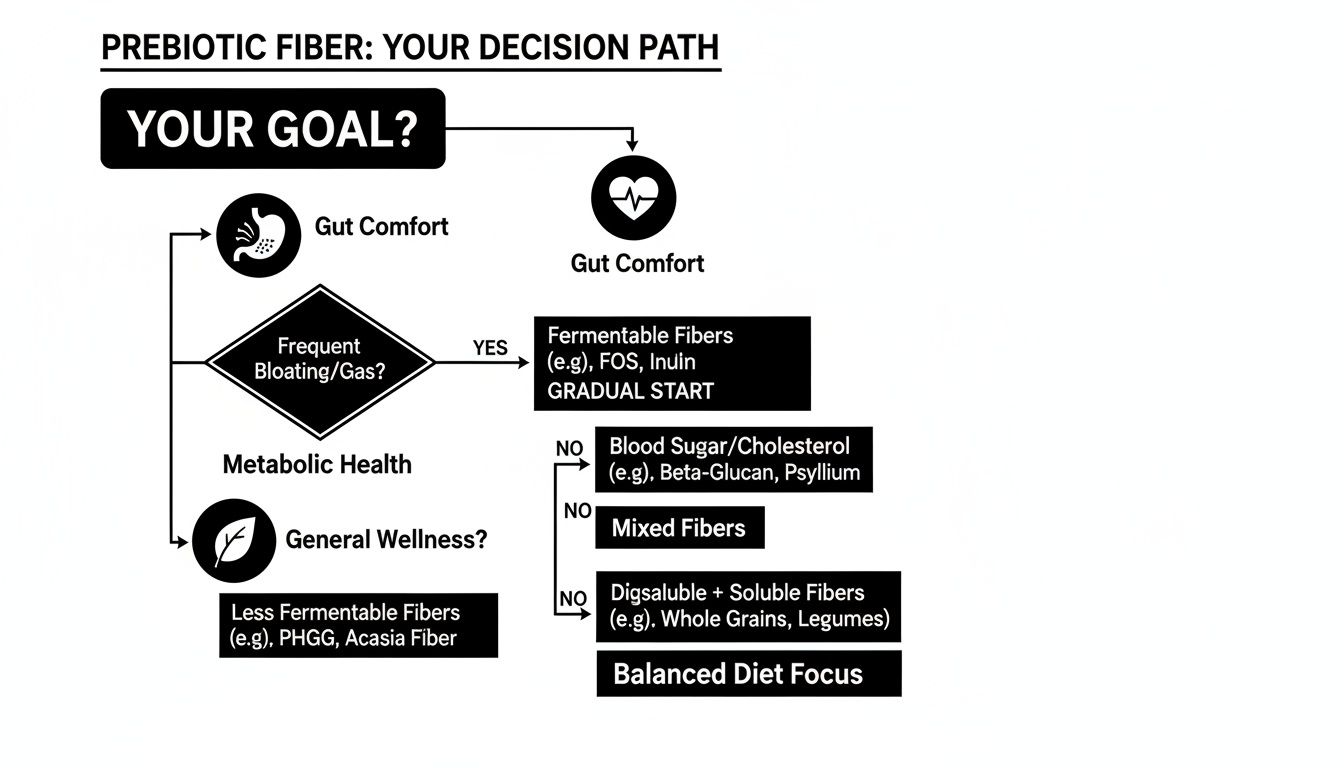
As you can see, someone prioritizing gut comfort should lean towards gentler fibers. Those focused on metabolic health might opt for fibers known to produce more butyrate.
Dosage And Delivery Form
How much fiber you get per serving makes a huge difference. How you take it also matters for your consistency and results. Powders are generally the most versatile and budget-friendly. They give you complete control over your dose. You can start small with a half-scoop (maybe 2.5 grams). You can work your way up as your system gets used to it.
Capsules, on the other hand, are the clear winner for convenience. They’re tasteless, mess-free, and perfect for travel. The trade-off is that you often need to swallow many large pills. A single capsule might only have 500–750 milligrams of fiber. You would need several to equal just one scoop of powder.
Key Takeaway: If you need a higher dose or want to fine-tune your intake, powders are the way to go. For pure, on-the-go convenience, capsules are unbeatable. This is true as long as you don’t mind taking multiple pills.
Putting It All Together: A Comparison For Real-World Goals
Let’s look at how these factors play out for two common goals. These are weight management and athletic performance.
For Weight Management:
Someone focused on weight loss should look for a supplement. It should contain glucomannan or a potent inulin powder.
- Why it works: These fibers create a thick gel in the stomach. This is fantastic for increasing feelings of fullness. It helps you naturally reduce how much you eat.
- What to look for: Look for a powder that provides at least 4–5 grams of soluble fiber per serving. Be sure to take it with plenty of water before a meal.
- Real-world scenario: Mix an unflavored scoop of inulin into a big glass of water. Drink it before dinner. It’s a simple trick to help curb your appetite and avoid overeating.
For Athletic Performance:
A runner or cyclist needs a supportive prebiotic. It should support their immune system and nutrient absorption. It should not cause gut mutiny during a workout.
- Why it works: A balanced microbiome can help lower exercise-induced inflammation. It can improve how well your body absorbs nutrients critical for recovery.
- What to look for: A gentle, easy-to-tolerate fiber is best. Acacia gum or partially hydrolyzed guar gum (PHGG) are good choices. A moderate dose of 3–5 grams is ideal.
- Real-world scenario: Add a scoop of tasteless, super-soluble acacia fiber to your morning smoothie. It’s an easy way to consistently feed your good gut bacteria. You can do this without risking bloat on your afternoon run.
Comparison Of Top Prebiotic Fiber Supplements
This table compares leading prebiotic supplements based on key criteria. This helps you choose the best option for your specific health goals.
| Supplement Name | Primary Fiber Type(s) | Form | Grams Per Serving | Best For | Key Feature |
|---|---|---|---|---|---|
| High-Potency Inulin Powder | Inulin from Chicory Root | Powder | 5-10g | Robust guts; maximizing fiber intake | High dose for strong gut-flora modulation |
| Gentle Acacia Powder | Acacia Fiber (Acacia Gum) | Powder | 3-7g | Sensitive stomachs; athletes | Tasteless and dissolves perfectly |
| Daily Prebiotic Capsules | Blend (Inulin, FOS, XOS) | Capsules | 1-2g | On-the-go convenience; taste sensitivity | Easy to take and portable |
By digging into these nuances, you can get past the marketing hype. You’ll be able to confidently pick a prebiotic fiber supplement. It will be the right fit for your body, your goals, and your daily routine.
How to Select the Right Supplement for Your Goals
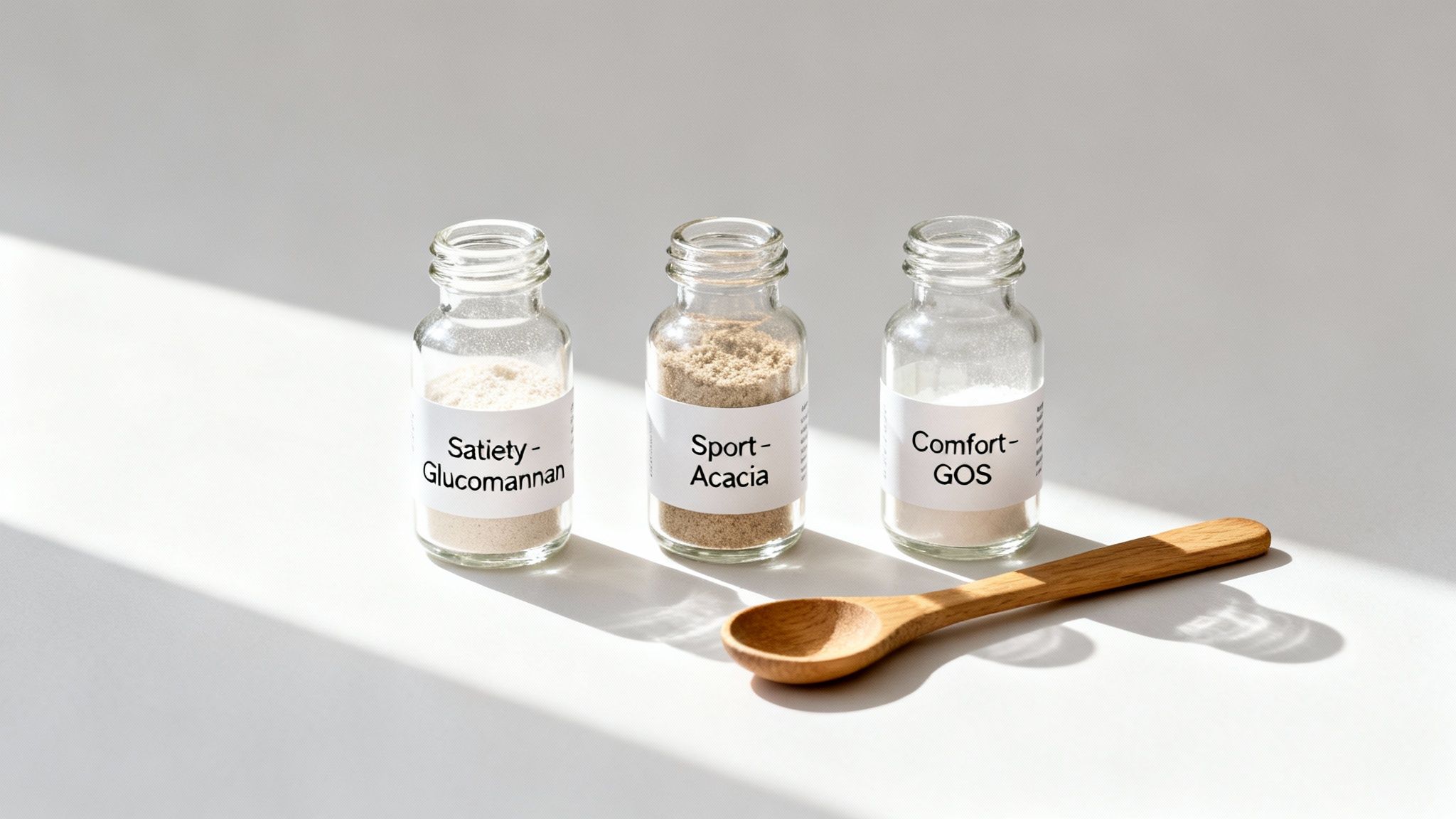
Choosing the right prebiotic means looking past marketing hype. You must match the supplement’s properties to your actual goals. Your reason for taking it should be the deciding factor. This is how you make sure the supplement is working for you. It should not cause new problems.
Thinking this way separates a random guess from an informed choice. An informed choice will genuinely support your health. Let’s break down how to pick the right product for two different scenarios.
Selecting a Prebiotic for Weight Management
If weight loss is your main objective, you need a certain prebiotic. You want one that helps you feel full and keeps your appetite in check. Certain fibers are brilliant at this. They work by absorbing water in your gut. They create a thick, gel-like substance that slows digestion. This helps you stay satisfied for hours.
Fibers like glucomannan and inulin are standouts here. They quite literally expand in your stomach. This can make a real difference in cutting down how much you eat. A consistent dose taken before meals can be a fantastic addition to a weight loss plan.
Here’s what to look for:
- Fiber Type: Zero in on soluble fibers known for creating that thick, viscous gel. Think glucomannan, psyllium husk, or a high-quality inulin powder.
- Dosage: An effective dose usually starts around 3-5 grams per serving. It’s critical to take it with a big glass of water. Take it about 30 minutes before you eat.
- Form: Powders are often the best bet. They make it easy to mix the fiber with enough liquid. This activates its gel-forming properties.
A smart way to start is with a smaller dose. See how your body handles it. You can slowly increase the amount over a week or so. This gives your gut time to adjust. It helps you sidestep any potential bloating or gas. For those who struggle with bloating, it might be worth looking into other products. You can learn more by reading our review of Zenwise No Bloat.
Choosing a Prebiotic for Athletic Performance
For athletes, the priorities are completely different. The goal is to nurture a healthy gut for better nutrient absorption. It also helps create a more robust immune system. All this must happen while avoiding digestive upset during a workout. The last thing you want is cramping because you picked the wrong fiber.
This is why easily tolerated, low-FODMAP fibers are the clear winners for athletes. These prebiotics ferment slowly. They feed your good gut bacteria without rapid gas buildup. This can prevent disaster mid-race.
Here’s what athletes should be focused on:
- Fiber Type: Gentle, slow-fermenting fibers are your best friends. Acacia gum and partially hydrolyzed guar gum (PHGG) are top-tier choices. They are highly soluble and won’t make you gassy.
- Dosage: A moderate daily dose of 3-6 grams is typically all you need. This supports your microbiome without causing trouble. Consistency is far more important than a massive dose.
- Timing: Taking your supplement at the same time every day helps. Mix it into a morning smoothie, for example. This helps keep your gut environment stable and happy.
By focusing on a gentle, steady intake, athletes can improve nutrient absorption. They can also help reduce inflammation. Both of these are critical for performance and recovery. For anyone wanting to fine-tune their approach, personalized health assessments can offer deeper insights. They guide you to the most effective prebiotic for your specific physiology.
Navigating Potential Side effects and Sensitivities
Bringing a prebiotic fiber supplement into your daily routine is a great move. But it’s not something you want to rush into. These fibers are a meal for your gut bacteria. A sudden buffet can cause a bit of a party in there. This can lead to temporary digestive complaints. This happens while your microbiome gets used to the new menu.
The most common things people notice at first are gas and bloating. You might also notice some mild stomach rumbling. Do not panic. This is usually a sign the prebiotic is working as it should. It is fermenting in your colon and feeding the good microbes. For most people, these initial symptoms are mild. They fade away within a week or two as their digestive system adapts.
Strategies for a Smooth Start
The golden rule for avoiding any discomfort is simple: start low and go slow. This is the single best piece of advice I can give. Almost every time I hear about someone having a bad experience, this is why. It’s because they jumped straight to the full dose.
Here’s a simple schedule to ease your body into it:
- Week 1: Start with just a quarter or half of the recommended daily serving.
- Week 2: If you’re feeling good, bump it up to half or three-quarters of a serving.
- Week 3: Now you can move up to the full recommended dose.
This gradual ramp-up gives your gut bacteria time to adjust. Also, make sure you’re drinking plenty of water. Staying well-hydrated helps soluble fiber move easily through your system. It can prevent any feelings of sluggishness.
Who Should Be Cautious
While most healthy adults handle prebiotics just fine, some people need to be careful. If you have pre-existing digestive issues, it’s essential to talk with your doctor. Talk to a registered dietitian before starting a new supplement. This applies even to a top-rated prebiotic fiber.
It is especially important for individuals with specific gut health conditions to seek medical advice. Abruptly adding certain fibers can sometimes worsen symptoms rather than improve them.
A few groups should be particularly mindful:
- Individuals with Irritable Bowel Syndrome (IBS): A lot of popular prebiotic fibers are high in FODMAPs. These are known triggers for people with IBS. If this is you, a low-FODMAP certified fiber is a safer bet. Partially hydrolyzed guar gum (PHGG) is a good example.
- Those with Small Intestinal Bacterial Overgrowth (SIBO): With SIBO, bacteria are already overgrown where they shouldn’t be. Adding more fermentable fuel can just feed the problem. It can make bloating and pain worse.
- People on a Low-FODMAP Diet: If you’re following a strict low-FODMAP diet, most common prebiotics are off-limits. Inulin and FOS are examples. Don’t add them unless you get the green light from your healthcare provider.
By starting slowly and listening to your body, you can tap into the fantastic benefits of prebiotics. You can do this while keeping any potential side effects at bay. When in doubt, a quick chat with a professional is always the smartest path forward.
Answering Your Questions About Prebiotic Fiber
Diving into the world of prebiotics can bring up a lot of questions. That’s perfectly normal. Let’s tackle some of the most common ones I hear. This will help you feel confident about what you’re putting in your body.
Can I Get Enough Prebiotics From Food Alone?
This is a great question. A diet packed with fiber-rich foods is the foundation of good gut health. Think garlic, onions, asparagus, and chicory root. However, getting a therapeutic dose of prebiotics from food alone can be tough.
Supplements are designed to bridge that gap. They provide a concentrated, reliable dose of specific fibers. This ensures your gut bacteria get a consistent meal every single day. For many people, that consistency is what really moves the needle. It takes gut health from “okay” to truly thriving.
How Long Does It Take to Notice Benefits?
The timeline really depends on where you’re starting from. Your current gut health, diet, and prebiotic all play a role.
Some people feel a difference within the first week. This can include better regularity and less bloating.
But for the deeper changes, you need to be patient. Real shifts in your microbiome take time. Give it at least a few weeks of daily use. Sometimes it can take a few months. Consistency is everything here.
Should I Take Prebiotics With Probiotics?
Combining prebiotics and probiotics can be a powerhouse move. This strategy, sometimes called synbiotics, is very effective. It is like sending in reinforcements (probiotics) with their food supply (prebiotics). It can really help the good bacteria set up shop and thrive.
But it’s definitely not a requirement. You can get fantastic results just by focusing on nourishing existing bacteria. If you’re struggling with gas and bloating, you might want to investigate. Check out the best probiotic for gas and bloating to see if a combined approach feels right. Ultimately, it comes down to your personal goals and listening to your body.
You may also find this Nutrition Geeks guide helpful: Best Supplements for Recovery and Inflammation Support.
You may also find this Nutrition Geeks guide helpful: Best Nitric Oxide Boosters for Runners: Why They Matter.
You may also find this Nutrition Geeks guide helpful: Exploring the Energizing Effects of White Maeng Da Kratom.
You may also find this Nutrition Geeks guide helpful: Find Your Local Herbalife Nutrition Centre Near Me: A 2026 Guide.
You may also find this Nutrition Geeks guide helpful: Unlock Your Wellness: Exploring the Benefits of Herbalife Nutrition Multivitamin Mineral and Herbal Tablets.
Frequently Asked Questions
What is the difference between prebiotics and probiotics?
Prebiotics are fibers that feed beneficial gut bacteria, while probiotics are live microorganisms.
Can prebiotic fiber cause gas?
Yes. Some people experience gas or bloating when increasing prebiotic fiber too quickly.
Looking for the Best Wellness Products?
Compare our top supplement reviews, recovery products, daily wellness essentials, protein picks, vitamins, and metabolism support guides all in one place.
Explore Wellness Shop →