Disclosure: This post may contain affiliate links, meaning if you decide to make a purchase through my links I may earn a commission at no additional cost to you. See my disclosure for more info.
Learning how to read nutrition labels is one of the most powerful skills you can develop as a runner. It's not just about counting calories. It's about turning a food package into a high-performance tool. This helps you fuel better, recover faster, and maintain energy on your runs.
Why Runners Need to Master the Nutrition Label
Think about your last trip to the grocery store. You were probably looking for a pre-run snack. You likely grabbed a bar and flipped it over. You joined the 83% of US consumers who say labels influence what they buy.
It's a big deal. A recent survey found that 64% of adults pay more attention to labels now. But there’s a catch. Roughly one in five shoppers find the information confusing. You can dig into these trends in the full NSF survey.
Explore more NutritionGeeks guides related to wellness, recovery, nutrition and active lifestyle support.
This guide is here to bridge that gap. It will turn that confusion into your competitive advantage.
See Past the Marketing Hype
Food packaging is prime real estate for marketing. We see flashy claims everywhere: "all-natural," "low-fat," "high in fiber." These phrases often don't tell the whole story.
More NutritionGeeks Wellness Guides
Explore more NutritionGeeks guides connected to wellness, recovery, hydration, energy, sleep and active lifestyle nutrition.
The nutrition label is your source of truth. It's standardized and regulated. It cuts right through the noise to show you what's really inside.
For instance, that "low-fat" yogurt might be loaded with added sugars. That’s a critical detail you'd miss otherwise. You would only see the front of the package.
The nutrition label has no agenda. It’s just data. It gives you the objective facts you need to decide if a food truly fits your goals.
Fueling for Peak Performance and Recovery
A runner’s body has specific demands. What you eat directly impacts your energy and endurance. It also affects how your muscles repair themselves. The nutrition label lets you make surgical choices to meet those needs.
- Pre-Run Fuel: You can spot snacks high in simple carbs for a quick energy boost. They should be low in fat and fiber to avoid an upset stomach.
- Post-Run Recovery: It helps you find foods with the ideal protein-to-carb ratio. This restocks your glycogen stores and kickstarts muscle repair.
- Everyday Nutrition: You can easily track key nutrients like iron, calcium, and protein. For more on this, check out our guide to the best foods for runners.
When you know how to read the label, you stop guessing. You start strategizing. You can confidently pick foods that build you up. It’s a game-changing skill.
Start at the Top: Serving Size and Calories
When you pick up a packaged food, look at the top of the label first. Here you'll find the serving size and servings per container. This is the key to understanding everything else listed below.
Think of the serving size as the official reference amount. All the numbers for calories, fat, and protein are based on that specific portion. It's easy to overlook this, but it's a common mistake. For instance, you might grab a bag of chips. A quick glance at the label reveals it actually contains three servings. If you eat the whole bag, you consume triple the calories, fat, and sodium.
Putting Serving Size into Perspective
Getting a real-world feel for serving sizes can be an eye-opener. That recommended ¾ cup of cereal on the box? It often looks tiny in an average breakfast bowl. The same goes for drinks. A 20-ounce soda isn't one serving; it's technically 2.5.
To get a better handle on this, here are a couple of tips:
- Break out the measuring cups: Just for a week, measure everything. Cereal, rice, nuts, even salad dressing. It feels tedious at first. But it trains your eyes to recognize a true portion.
- Use visual cues: You can't always carry measuring spoons. Instead, learn some simple comparisons. A serving of meat is about the size of a deck of cards. A serving of cheese looks like four stacked dice.
Making a habit of checking the "Servings Per Container" first will change how you read a label. It's a simple step that prevents you from derailing your nutrition goals.
This flowchart breaks it down. It shows how a quick label scan leads to smarter choices for your health.
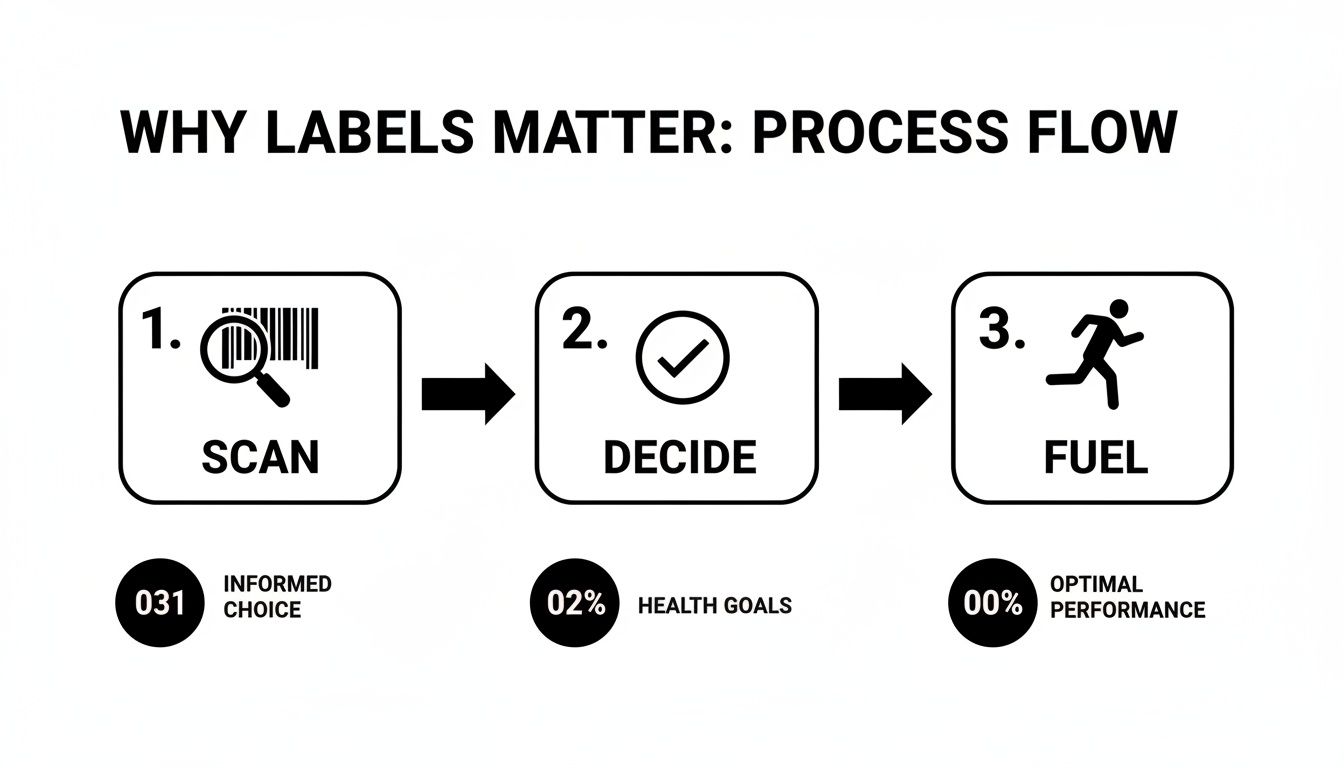
As you can see, it all starts with that simple scan. It’s the first step toward making a choice that aligns with your body's needs.
Understanding Calories for Your Goals
Once you've figured out the serving size, the next stop is calories. It's always in a big, bold font for a reason. It tells you how much energy you'll get from one serving. This number is critical for fueling a marathon or managing your weight.
Remember that the 2,000-calorie figure on labels is just a general guideline. Your actual daily needs are unique. They depend on your age, sex, activity level, and goals.
For runners, calories are pure fuel. You have to consume enough to power through your workouts. Skimping on calories can lead to fatigue and poor performance. The label is your tool for finding energy-dense foods. If you're unsure what your personal target is, our guide on how to calculate daily calorie needs can help.
If weight loss is the goal, the calorie count helps you stay in a healthy energy deficit. By knowing the numbers, you can build satisfying meals that fit your daily budget. This makes the process feel less restrictive and more sustainable.
Get to Know the Nutrients: Macros and Micros
Alright, once you've clocked the serving size and calories, it's time to dive in. This is where we find the macronutrients—fat, carbohydrates, and protein. These are the major players providing energy and structure for your body.
Think of this section as the food's resume. It tells you exactly what it's made of. It explains what it can do for you. This impacts everything from performance to your overall health. It’s not just about the amount of fat or carbs, but the type.
Breaking Down Fats: Total, Saturated, and Trans
The Total Fat number is your starting point. The real story is in the fine print right below it. The label breaks out saturated and trans fats. They have a significant impact on heart health.
- Saturated Fat: This is one you'll want to keep an eye on. A high intake is linked to higher levels of "bad" cholesterol. Moderation is key.
- Trans Fat: This is the one to avoid completely. Aim for 0g on the label. Always scan the ingredients list for "partially hydrogenated oils." A loophole allows companies to claim 0g if a serving has less than 0.5 grams.
- Unsaturated Fats: These are the good guys. They're the heart-healthy fats found in avocados, nuts, and olive oil.
For runners, healthy fats are an indispensable fuel source. They also play a massive role in fighting inflammation. My advice? Focus on getting plenty of unsaturated fats. Keep saturated fats low and trans fats at zero.
All About Carbs: Fiber, Total Sugars, and Added Sugars
Carbohydrates are the body's preferred fuel source, especially for athletes. The label splits this category into a few key lines. This gives you the real scoop on how a food will impact your energy.
The Total Carbohydrate figure lumps everything together. The details underneath are what you really need to see. Dietary Fiber is a powerhouse carb your body can't digest. It's fantastic for gut health and keeping blood sugar stable.
Paying attention to fiber can have a huge impact. People who read nutrition labels are up to 3.4 times more likely to hit their daily fiber goals. That's a massive advantage. Only about 5-10% of Americans get enough. You can learn more about these important findings on fiber intake and label reading.
The other line to watch is Includes Added Sugars. This value isolates sugars added during processing. A high number here is often a red flag for energy crashes. Your goal should be to keep this number as low as possible.
Protein for Muscle Repair and Recovery
Protein is the ultimate repair crew for your body. It's essential for rebuilding tissues. This is critical for runners who are constantly breaking down muscle fibers. The label gives you a straightforward count of total protein grams per serving.
When you're grabbing a post-run snack, look for a decent protein count. This helps kickstart that muscle repair process. Knowing how to spot it on a label helps you refuel strategically. If you want to get specific, check our guide on calculating protein intake for runners.
The "big three" macros—fat, carbs, and protein—give you the main story. But to make the quickest decisions, you need one more tool.
Using Percent Daily Value: The 5/20 Rule
Look over to the right side of the label. You'll see the Percent Daily Value (%DV). This is a handy shortcut. It shows how much a nutrient in one serving contributes to a standard 2,000-calorie diet.
The easiest way to use this is with the 5/20 Rule. It’s a simple, brilliant trick I use all the time.
A rule of thumb like this can help you quickly gauge a food. You can see if it's high or low in a nutrient. This makes for faster, healthier choices while you shop.
Quick Guide to Percent Daily Value (%DV)
| %DV Level | What It Means | Good For Nutrients Like… | Limit For Nutrients Like… |
|---|---|---|---|
| 5% or less | Low | Saturated Fat, Sodium, Added Sugars | Fiber, Vitamin D, Calcium, Iron, Potassium |
| 20% or more | High | Fiber, Vitamin D, Calcium, Iron, Potassium | Saturated Fat, Sodium, Added Sugars |
So, what does this look like in practice?
- If a nutrient has 5% DV or less, that food is considered low in that nutrient.
- If it has 20% DV or more, it's considered high.
This rule makes comparing products a breeze. Searching for a high-fiber cereal? Scan for options with a DV of 20% or more for fiber. Trying to cut back on sodium? Look for foods with a DV of 5% or less. This simple guideline is a practical skill to master reading a nutrition label.
Look Beyond the Numbers at Ingredients and Allergens
The nutrition facts panel gives you a great snapshot. But it doesn't tell the whole story. To really know what you're eating, look at the ingredients list. This is where the truth about a food's quality comes out.
Think of it this way: the facts panel is the "what," and the ingredients list is the "how." The single most important thing to remember is that ingredients are listed in descending order by weight.
That means the first few ingredients are what you're mostly eating. This is a game-changer. If you see sugar or refined flour as one of the first ingredients, that's the main event. It's a quick way to separate nutritious foods from highly processed ones.
Decoding the Ingredients List Like a Pro
Scanning an ingredients list shouldn't feel like a chemistry textbook. Once you know what to look for, you can size up a product in seconds. My first move? I look for a short list filled with real, recognizable foods.
A super long list packed with words you can't pronounce is a red flag. It points to a heavily processed product. Let's say you're comparing two granola bars. One might list "oats, dates, almonds" as its first three ingredients. The other could start with "high-fructose corn syrup, enriched flour, palm oil." The choice becomes pretty obvious.
A great rule of thumb is to pick products where the first three ingredients are kitchen staples. This simple check is one of the fastest ways to filter out junk.
The Many Disguises of Added Sugar
Spotting hidden sugar is a critical skill when reading ingredients. Food manufacturers have gotten clever at hiding it. They use dozens of different names to downplay how much is really in there.
It can get confusing. Knowing the most common aliases makes a huge difference.
- Any kind of syrup: High-fructose corn syrup, brown rice syrup, agave syrup.
- Words ending in "-ose": Dextrose, fructose, sucrose, maltose.
- Other common culprits: Cane juice, fruit juice concentrate, molasses, honey.
When you see several different types of sugar, that’s a dead giveaway. It’s a common tactic to keep "sugar" from being the first ingredient.
Identifying and Understanding Allergens
For millions of people, the ingredients list is a critical safety check. Food allergies are serious. Thankfully, manufacturers are required to make major allergens easy to spot.
The FDA requires clear labeling for the eight most common food allergens. These are milk, eggs, fish, shellfish, tree nuts, peanuts, wheat, and soybeans. You’ll find this information in one of two places:
- Directly in the ingredients list: The allergen will be in parentheses, like "whey (milk)."
- In a separate "Contains" statement: A line below the ingredients states, "Contains: Wheat, Milk, and Soy."
If you have a known allergy, check this section every time. It's also helpful for those with digestive issues. For example, finding the best protein powder for a sensitive stomach comes down to scanning these statements. A quick glance can save you a lot of discomfort later.
Putting It All Into Practice: Real-World Scenarios
Alright, let's move from theory to action. The real power of understanding nutrition labels comes when you're in the grocery store. You are trying to make a choice that aligns with your goals. These examples show you how to apply what you've learned.
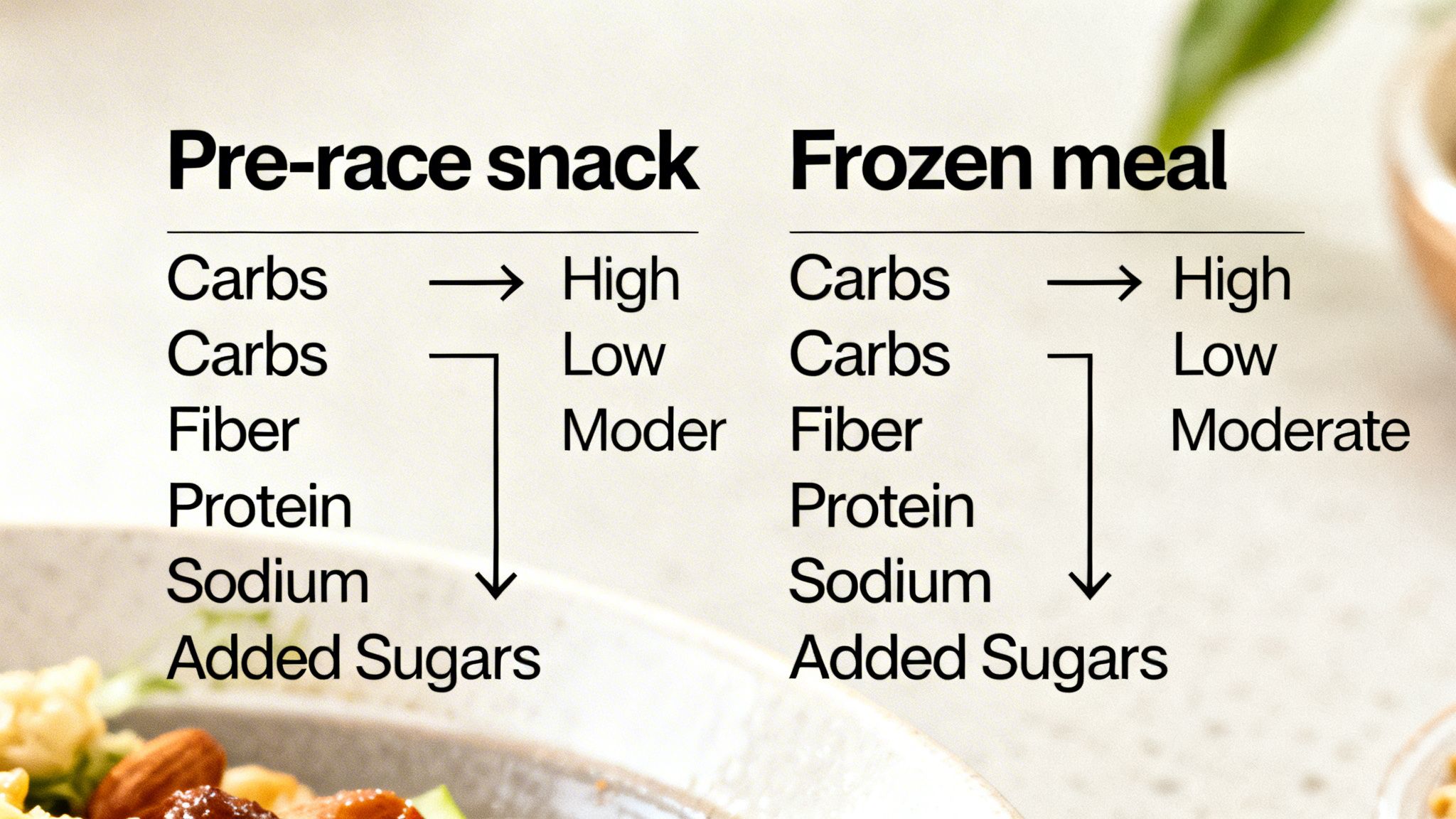
The Runner's Dilemma: Choosing a Pre-Race Snack
Imagine you're about to run a 10K. You need a quick snack that provides energy without causing stomach issues. You have two different energy bars. Let's break them down.
For a pre-run snack, you're primarily looking for:
- Carbohydrates for quick fuel.
- Low to moderate Fiber to avoid gut distress.
- Minimal Protein so it digests quickly.
- Low Added Sugars to prevent an energy crash.
Here's a side-by-side comparison:
| Nutrient | Bar A (Per Serving) | Bar B (Per Serving) |
|---|---|---|
| Total Carbs | 30g | 28g |
| Dietary Fiber | 2g | 4g |
| Protein | 5g | 7g |
| Added Sugars | 8g | 6g |
At first glance, they look pretty similar. But for this specific purpose, Bar B is the winner. It provides a solid amount of carbs and just 6g of added sugar. Its 4g of fiber is enough to be satisfying without being heavy.
I've learned this the hard way. A bar similar to A once left me hitting a wall. But something like Bar B has consistently carried me through. The numbers on the label are your starting point. But personal experience confirms the right choice.
Also, don't forget to glance at the sodium. For shorter runs, a snack with under 150mg is a good target.
A great pre-run snack is all about balancing fast energy with digestive comfort. Those few grams of fiber or sugar can make all the difference.
Quick Fueling Tips for Runners
Reading the label is step one. Step two is testing it out. Finding your perfect race-day fuel takes trial and error.
- Experiment with different carb and fiber levels during training runs.
- Eat a test snack 30-45 minutes before a workout.
- Keep a simple log: note the snack, how you felt, and your performance.
The golden rule of racing applies here: nothing new on race day. Use your training runs to dial in your nutrition. You can line up at the start with complete confidence.
The Weeknight Meal Showdown: Picking a Healthy Frozen Dinner
It's late, you're tired, and you need a quick, satisfying meal. The frozen food aisle can be a minefield. The nutrition label is your map.
Let's say you're comparing two options. You want a meal that will keep you full and nourished. You're looking for a good balance of:
- Protein for satiety.
- Fiber to keep you full.
- Sodium that's not off the charts.
- Minimal Added Sugars.
Here’s the breakdown for Meal X and Meal Y:
- Meal X: 20g protein, 8g fiber, 650mg sodium, 5g added sugars.
- Meal Y: 15g protein, 12g fiber, 450mg sodium, 2g added sugars.
For a regular weeknight dinner, Meal Y is the smarter choice. It has significantly more fiber to keep you feeling full. It has much lower sodium and almost no added sugar. While Meal X has more protein, the overall profile of Meal Y is better.
A personal shopping hack I use for frozen meals is simple. I look for at least 10g of fiber, under 600mg of sodium, and no more than 5g of added sugars. This simple rule helps me scan and compare options quickly.
And always scan the ingredients list. I chose Meal Y and noticed it was packed with real vegetables. This adds a nutrient punch beyond what the macros tell you.
Don't Forget About Portion Control
Here’s a classic trap: many frozen meals contain two servings. It's easy to eat the whole container without realizing it. You've just doubled the calories, sodium, and fat.
- When you get home, divide two-serving meals into separate containers.
- Use a food scale to measure out a single serving before you heat it.
- Freeze the extra portion for an easy lunch or dinner later.
This simple habit ensures the numbers you read on the label are the numbers you're actually eating.
With these skills, you're ready for more advanced strategies. Like creating an inexpensive healthy grocery list that doesn't compromise on nutrition.
Remember, consistency trumps perfection. Making small, informed choices every day leads to big results.
Next, we’ll tackle some of the most common questions about nutrition labels.
Your Top Questions About Nutrition Labels, Answered
Even after you get the hang of reading a nutrition label, some tricky questions pop up. Think of this as the expert-level Q&A session. Answering these common head-scratchers will sharpen your skills. It will give you that extra confidence in the grocery store aisles.
Let's dive into the questions I hear most often.
What’s the First Thing I Should Look at on a Label?
This is a classic question. The "right" answer depends on your specific goals. I always tell people to start with the serving size. Why? Because every single number on that label is based on that one amount. If you eat double the serving size, you have to double everything else.
Once you’ve got that down, your focus can shift based on your goals:
- For runners: I'd zero in on carbohydrates for fuel. Look for protein for post-run muscle repair.
- For weight management: The big three are calories, protein, and fiber. That protein-fiber combo is a powerhouse for keeping you full.
Ultimately, there's no single "most important" item. It's about learning to quickly find the information that matters most to you.
Just How Accurate Are Nutrition Labels Anyway?
This is a great question. The answer might surprise you. The FDA allows for a 20% margin of error on nutrition labels. That means a snack listed as 100 calories could have 80 to 120 calories.
For most of us, this little variance won't derail our health goals. But it’s a reminder that whole foods—like an apple—don't have this ambiguity. Their nutritional value is naturally consistent.
Think of the label as a reliable guide, not an exact scientific document. This small margin of error is another reason to focus on overall eating patterns.
I See “Net Carbs” on a Lot of Packaging. Does That Matter?
You've probably seen "net carbs" on keto-friendly products. It's important to know this is a marketing term. It is not an official one regulated by the FDA. It’s calculated by taking the Total Carbohydrate number and subtracting fiber and sugar alcohols.
The idea is that fiber and sugar alcohols don't raise your blood sugar. While that might be useful for a strict ketogenic diet, it's not the most practical number.
A much better strategy is to simply look at the official 'Total Carbohydrate' and 'Dietary Fiber' lines. Making sure your carbs are from high-fiber sources is a tried-and-true approach. It provides sustained energy and good digestive health.
What Does It Really Mean if a Label Says 0g of Trans Fat?
This is one of the trickiest parts of a nutrition label. FDA rules allow companies to claim 0g of trans fat as long as the food has less than 0.5 grams per serving. That might not sound like a lot. But if you eat more than one serving, those fractions can add up.
So, how can you be sure? You have to become an ingredient detective.
Ignore the front of the box and the numbers on the panel for a second. Go straight to the ingredients list. Scan for one specific red flag: "partially hydrogenated oil."
If you see those words, the product contains trans fat, period. It doesn't matter what the nutrition facts say. For your heart health, it's best to avoid this ingredient completely. If you're interested in digging deeper, you can find additional insights and articles on health and wellness covering a wide range of topics.
You may also find this Nutrition Geeks guide helpful: Authentic Maltese Stuffat tal-Fenek: A Hearty Rabbit Stew Recipe.
You may also find this Nutrition Geeks guide helpful: Unlock the Benefits: Brewing the Perfect Cumin Powder Tea.
You may also find this Nutrition Geeks guide helpful: Gluco Shield Pro: What Real Users Are Saying About This Blood Sugar Supplement.
You may also find this Nutrition Geeks guide helpful: Experience the Energy Boost with Herbalife Liftoff: New Flavors and Benefits.