Disclosure: This post may contain affiliate links, meaning if you decide to make a purchase through my links I may earn a commission at no additional cost to you. See my disclosure for more info.
Learning how to start running for beginners is about starting smart. You must build a habit you actually enjoy. The most effective way for beginners is the walk-run method. It’s a simple strategy. It lets your body adapt to running without getting overwhelmed.
This is all about consistency. It is not about intensity. Forget about pace or distance for now. Your only job is to get out the door. Then, follow the plan.
Your First Steps Into The World Of Running
Jumping into a running routine can feel intimidating. But it’s more approachable than you might think. The real secret is a smart plan. It builds your fitness gradually. This is how you avoid burnout and injuries. These issues sideline many new runners.
Explore more NutritionGeeks guides related to wellness, recovery, nutrition and active lifestyle support.
Your journey starts with a simple commitment to move. It is not a full-blown sprint. You will mix short bursts of running with walking breaks. This gives your joints, muscles, and lungs time to catch up. This is the core of the walk-run method. It is the foundation of every successful beginner program. It works.
Set A Realistic Goal
Having a clear, attainable target is a great way to stay motivated. For most new runners, a 5K (3.1 miles) is the perfect first goal. It's a distance that feels like a real accomplishment. But it does not require a life-altering training commitment.
More NutritionGeeks Wellness Guides
Explore more NutritionGeeks guides connected to wellness, recovery, hydration, energy, sleep and active lifestyle nutrition.
When you're training for a 5K, every session has a purpose. You’re taking a concrete step toward a tangible achievement. That sense of progress is a huge motivator. It helps on days when lacing up feels like a chore.
The sport is seeing a huge influx of new faces. Recent data shows that 53% of participants in major running events were first-timers. This boom proves that accessible races like the 5K are the ideal gateway. Discover more insights on the rise of beginner runners.
Create A Sustainable Schedule
When you're just starting out, consistency beats intensity. Plan to run three times a week on non-consecutive days. Think Monday, Wednesday, and Friday. This gives your body enough training stimulus to adapt and get stronger. It also provides essential time for recovery.
Don't underestimate the power of rest. Your muscles repair and build strength on your days off. Trying to run every day as a beginner is a fast track to injury.
Pull up your calendar. Block out 30-minute appointments for your runs. Treat them with the same importance as any other meeting. Find what works for your life and stick with it. Building this routine turns running into a non-negotiable part of your week.
Here's a straightforward plan for your first week. The goal is to finish each session feeling good, not exhausted.
Sample First Week Walk-Run Plan (3 Sessions)
| Day | Activity | Duration |
|---|---|---|
| Day 1 | 5-minute brisk walk warm-up. Then alternate 60 seconds of running and 90 seconds of walking for 20 minutes. 5-minute walk cool-down. | 30 minutes |
| Day 2 | Rest or cross-train (e.g., walk, swim, cycle) | – |
| Day 3 | 5-minute brisk walk warm-up. Then alternate 60 seconds of running and 90 seconds of walking for 20 minutes. 5-minute walk cool-down. | 30 minutes |
| Day 4 | Rest | – |
| Day 5 | 5-minute brisk walk warm-up. Then alternate 60 seconds of running and 90 seconds of walking for 20 minutes. 5-minute walk cool-down. | 30 minutes |
| Day 6 | Rest | – |
| Day 7 | Rest or active recovery (e.g., gentle stretching, long walk) | – |
This simple schedule is your foundation. As weeks go on, you'll increase the running intervals. You will also decrease the walking until you're running continuously.
Choosing The Right Gear Without Breaking The Bank
When you start running, you might think you need lots of gear. The good news? You don't. But there is one piece of equipment that's non-negotiable. You need a good pair of running shoes.
Sure, you can run in an old cotton t-shirt. But your shoes are your first line of defense against impact. They protect your joints. They support your feet. They make the difference between a great run and a painful one. The wrong shoes can lead to blisters or shin splints. Investing here is the smartest move a new runner can make.
Finding Your Perfect Running Shoe
Walking into a running store can feel intimidating. You'll hear words like "pronation" and "stack height." Let’s simplify it. Pronation is the natural way your foot rolls inward. Some people overpronate (roll in too much). Others supinate (roll outward).
The best way to figure this out is to visit a specialty running store. Ask for a gait analysis. An expert will watch you walk or run. They will recommend shoes for your specific foot mechanics. This service is almost always free. It can save you a world of hurt down the road.
Don't get caught up in brand loyalty or cool colors. The "best" shoe is the one that disappears on your foot. Always trust how it feels over what the marketing says.
You'll also want to think about cushioning. Some runners love a soft ride. Others prefer a firmer, more responsive feel. There's no right answer. It all comes down to personal comfort. Try on a few different types to see what you like. Learn more in our guide to the best running shoes for marathon training.
What You Actually Need vs. What’s Nice to Have
Once your shoes are sorted, the rest can be simple. The main goal is to choose comfortable clothing. It should prevent annoyances like chafing and blisters.
Here are the true must-haves:
- Moisture-Wicking Socks: Never run in cotton socks. Cotton is like a sponge for sweat. It holds moisture against your skin. This creates the perfect environment for blisters. Grab socks made from a synthetic blend or wool.
- Comfortable Apparel: You don’t need pricey outfits. Look for shorts, leggings, or shirts made from technical fabrics. These materials pull sweat away from your body. This keeps you dry and prevents a sticky feeling.
After you've logged some miles, you might consider a few extras:
- Running Watch or Fitness Tracker: A basic watch that tracks time and distance is useful. Seeing your progress in black and white is a huge motivator.
- Running Belt or Armband: This keeps your essentials from bouncing around in your pocket.
If you go the fitness tracker route, consider the band. A quality nylon watch strap can improve comfort. Just remember the golden rule. Start with essentials. Add more gear only when you feel a real need for it.
Building Your Beginner Running Plan Week By Week
When you’re just starting out, consistency is everything. This eight-week plan is your guide. It takes you from mostly walking to jogging for 30 minutes. It's designed to feel tough but totally doable. You build strength and confidence one week at a time.
Plan on three running sessions each week. They must be on non-consecutive days. This is a non-negotiable part of the process. Giving your body a day off in between lets it adapt. Your muscles, joints, and tissues get stronger. Jumping in too fast is a classic beginner mistake. So learn to love those rest days.
The whole approach is about gradual progression. Each week, you'll run a little more and walk a little less. This slow-and-steady method prevents shocking your system. It helps you build a solid aerobic base. It keeps the journey from feeling overwhelming.
Weeks 1 and 2: Establishing Your Base
The first couple of weeks get your body used to this new demand. You'll actually be walking more than you run. This is by design. The goal is to finish each session feeling good. You should not feel completely wiped out.
- Week 1: For your three workouts, start with a 5-minute warm-up walk. Then, alternate 60 seconds of running with 90 seconds of walking for 20 minutes. Wrap it up with a 5-minute cool-down walk.
- Week 2: You’ll now run for 90 seconds and walk for 2 minutes. Repeat this cycle for 20 minutes. Don't forget the warm-up and cool-down!
This gentle start helps you build the habit. You're laying the foundation for everything that comes next.
Weeks 3 and 4: Building Momentum
With a baseline established, it's time to run more. You’ll notice the running chunks get longer. The walking breaks get shorter. This is where your cardiovascular system kicks into a higher gear.
You're no longer just trying to run; you're actively training. Each session is an investment in your fitness. You'll start to feel the payoff.
Things might feel a bit more challenging during these weeks. That's a good sign. Just remember to listen to your body. Keep the pace conversational. If you're too winded to string words together, ease up.
As you progress, the right gear becomes even more important. Getting the right shoes is about what works for your feet.
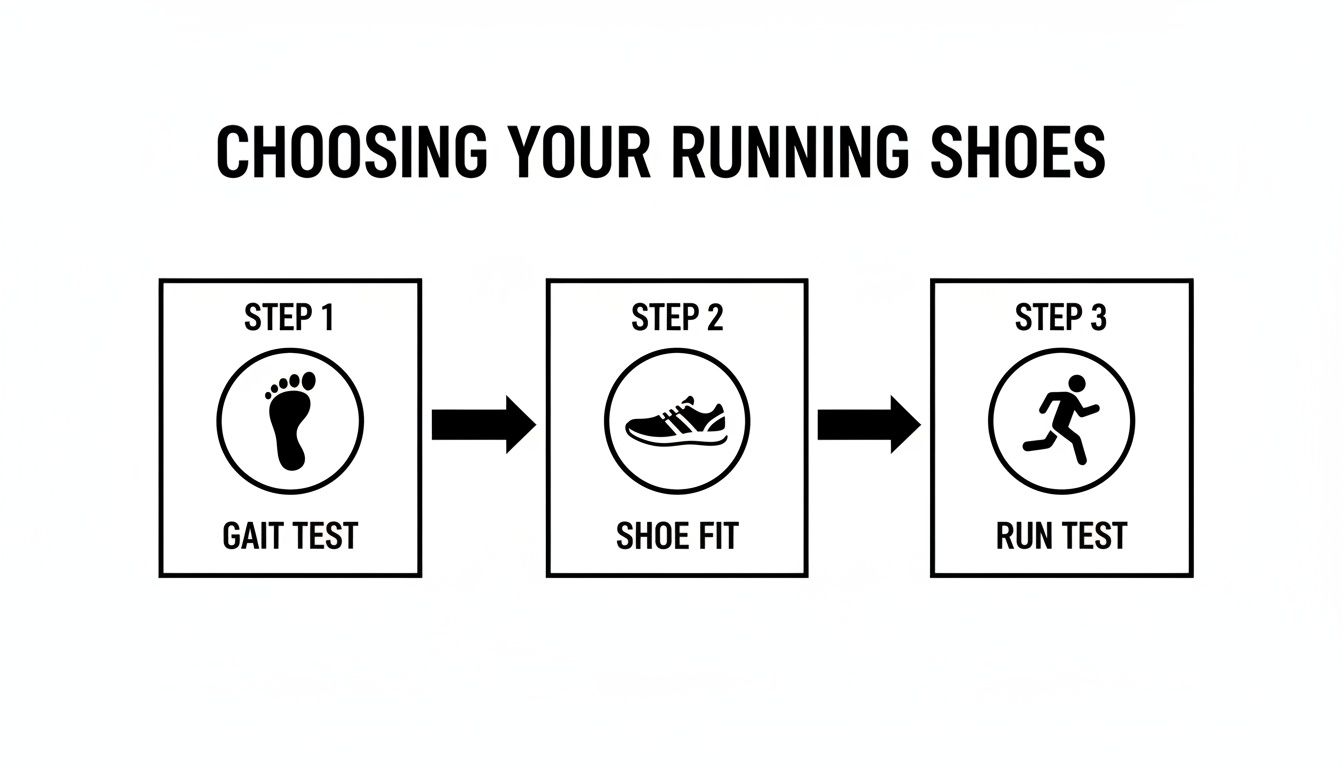
This simple process can make all the difference in preventing injuries.
8-Week Beginner Running Schedule Overview
Here’s a quick look at the run/walk interval progression. It’s a clear path from starting out to running for 30 minutes straight.
| Week | Run Interval | Walk Interval | Total Time |
|---|---|---|---|
| 1 | 60 seconds | 90 seconds | 20 minutes |
| 2 | 90 seconds | 2 minutes | 20 minutes |
| 3 | 3 minutes | 3 minutes | 24 minutes |
| 4 | 5 minutes | 3 minutes | 24 minutes |
| 5 | Varies | Varies | ~25 minutes |
| 6 | Varies | Varies | ~25 minutes |
| 7 | 28 minutes | None | 28 minutes |
| 8 | 30 minutes | None | 30 minutes |
Seeing it laid out like this shows how each week builds on the last. You've got this!
Weeks 5 and 6: The Turning Point
This is often where the magic happens. The workouts get tougher. But your fitness gains become undeniable. Week 5 features a big jump in continuous running. It might look scary on paper. But the previous four weeks have prepared you for it.
- Week 5: Your three runs will be different this week.
- Run 1: Run 5 min, walk 3 min. Repeat 3 times.
- Run 2: Run 8 min, walk 5 min. Repeat 2 times.
- Run 3: Go for it—run 20 minutes straight with no walking breaks.
- Week 6: You'll build on that 20-minute achievement.
- Run 1: Run 5 min, walk 3 min, run 8 min, walk 3 min, run 5 min.
- Run 2: Run 10 min, walk 3 min, run 10 min.
- Run 3: Push it to 25 minutes straight.
These longer efforts build mental grit. Proving you can run for 20 minutes without stopping is a huge confidence booster. It's the moment you stop "trying to run." You start feeling like a runner.
Weeks 7 and 8: Becoming a Runner
In these last two weeks, you'll cement your hard work. You'll get comfortable running for longer periods. The walking breaks are a thing of the past. The goal now is continuous running.
You might even be thinking about what’s next. Many runners use this plan as a springboard for a 5K. The New York City Marathon had 51,402 finishers in 2023. This shows just how far you can take this.
Many people start running in their 20s. But over half begin after age 30. It's never too late. If you're curious about a bigger goal, check out these marathon training plans for beginners.
By the end of Week 8, you'll have the stamina to run for 30 minutes. You've built a powerful habit. You unlocked a new level of fitness. You crushed a goal that might have seemed impossible two months ago.
Essential Warm-Ups, Cool-Downs, and Injury Prevention

If you take away one thing, let it be this. Don't skip your warm-up and cool-down. I see it all the time with new runners. They’re eager to get going. But treating these routines as optional is a fast way to get injured.
Think of them as essential bookends to your run. They wake your body up for the work ahead. Then they kickstart the recovery process afterward. This small time investment dramatically lowers your risk of getting hurt.
Priming Your Body the Right Way With Dynamic Stretches
Jumping from the couch to a run is a shock to cold muscles. A proper warm-up eases you into it. It gradually increases your heart rate. It sends blood to your muscles. This makes them more pliable and ready to go.
Before you run, get your body moving with dynamic stretches. These are active movements that mimic running. They are unlike the static stretches from gym class. Save those for later.
Start with a brisk five-minute walk. Once you feel warmer, spend a few minutes on these key moves:
- Leg Swings: Find a wall for balance. Swing one leg forward and back 10–12 times. Then switch to side-to-side swings. Repeat with the other leg to open up your hips.
- High Knees: March or jog lightly in place. Drive your knees up toward your chest. This fires up your hip flexors and glutes. Keep it going for about 20–30 seconds.
- Butt Kicks: Now, do the opposite. Jog in place. Focus on kicking your heels back toward your glutes. This is fantastic for waking up your hamstrings.
These simple drills prime your muscles for the impact of running. You'll find the first few minutes feel much smoother.
Mastering the Cool-Down for Faster Recovery
When you finish your run, resist the urge to just stop. Your heart is still beating fast. Your muscles need a chance to transition back to a resting state. A good cool-down reduces next-day soreness. It also improves long-term flexibility.
Learning how to cool down after your workout is crucial. Start with a five-minute walk. Let your heart rate settle down. After that, it’s time for static stretches. Now, you’ll hold each stretch for 30–60 seconds. This helps lengthen the muscles you just worked.
Hit all the major running muscles:
- Hamstrings: Lie on your back. Lift one leg straight up. Gently pull it toward you.
- Quads: While standing, grab your foot. Pull your heel toward your glute. Try to keep your knees aligned.
- Calves: Face a wall. Place your hands on it. Step one foot back. Press that heel into the floor.
- Glutes: Lie on your back. Cross one ankle over the opposite knee. Gently pull the bottom leg toward your chest.
Preventing Common Beginner Running Injuries
Let's be real. Injury is the biggest hurdle for new runners. Studies show beginners can face up to a 50% risk of injury. This is often because they do too much, too soon. But with the right approach, you can beat those odds.
Listen to your body. This is the golden rule of running. Learn the difference between soreness and the sharp pain of an injury. Never push through pain that is sharp or getting worse.
Two common complaints are shin splints and runner's knee. Shin splints feel like a dull ache along your shin bone. Runner's knee is pain around your kneecap. For a deeper dive, check our guide on how to prevent running injuries.
Your best defense is a strong foundation. Two short strength sessions a week can make a massive difference. You don't need a gym. Focus on bodyweight moves like squats, lunges, and planks. These build strength in your hips, glutes, and core. This takes stress off your knees and lower legs.
Fueling Your Runs: Basic Nutrition and Hydration

Running performance isn't just about your legs and lungs. What you eat and drink plays a huge role in your energy levels. It also affects how you recover. Fueling for a run doesn't have to be complicated.
For new runners sticking to shorter distances, your current meals are enough. The trick is making smart choices around your workouts. Think of food as fuel and water as coolant.
What To Eat Before A Run
Timing is everything for a pre-run snack. Eat a small, easily digestible meal about 60 to 90 minutes before you run. This gives your body time to process the food into energy. You won't feel heavy or sluggish.
The main event here is carbohydrates. Carbs are your body’s go-to source for quick energy. Topping off your stores ensures you have that get-up-and-go. Avoid anything high in fat, fiber, or protein right before a run. They can slow digestion and lead to stomach cramps.
Here are a few simple, effective ideas:
- A small banana
- A piece of toast with a bit of jam
- A small bowl of oatmeal
- A handful of pretzels or crackers
These options give you a quick burst of energy. They won't weigh you down. As you get more into running, fine-tune your diet. Check our guide on the best foods for runners.
Staying Properly Hydrated
You absolutely can't ignore hydration. Even being slightly dehydrated can zap your energy. It can bring on muscle cramps. It makes your run feel way harder than it should. The golden rule? Don't wait until you're thirsty to drink.
Your goal should be to stay hydrated all day long. A good guideline is to drink about half your body weight in ounces of water. So, if you weigh 150 pounds, aim for around 75 ounces of water.
Pro Tip: Keep an eye on the color of your urine. If it’s light yellow, you're doing great. If it’s dark yellow, it's time to drink some more water. It's a simple and effective way to check your hydration.
Post-Run Recovery Fuel
What you eat after your run is just as important as lessening pre run breakfast stomach issues.. Your body has just put in serious work. It needs the right nutrients to repair muscle and restock energy. The best time to refuel is within 30 to 60 minutes of finishing.
Your recovery meal should have both carbohydrates and protein. Carbs replenish your depleted glycogen stores. Protein provides the amino acids for muscle repair. Aim for a 3:1 or 4:1 ratio of carbs to protein.
A few great recovery options include:
- Chocolate milk (a runner’s classic!)
- A smoothie made with fruit and Greek yogurt
- A turkey sandwich on whole-wheat bread
- Yogurt topped with a handful of berries
Start with simple things like bananas for potassium. Or use electrolyte gels to help avoid dehydration. This straightforward approach helps your body bounce back quicker. You'll be ready for your next run.
Staying Motivated And Overcoming Common Hurdles
Let's be honest. Even seasoned runners have days where the couch looks more inviting. That initial excitement won't last forever. The habits and mental tricks you build will keep you going.
One of the oldest tricks is accountability. You’d be surprised how much harder it is to skip a run when you’ve told a friend. Even better, convince that friend to join you. Knowing someone is waiting for you is often the only push you need.
Finding Your Why And Building Momentum
When motivation is flagging, remember why you started. Is it for your health? To blow off steam? To tackle a big challenge? Whatever your reason, hold onto it. It's your anchor on the tough days.
You can also create your own momentum. A killer running playlist can change my mindset. Or, if you’re data-driven, watch your progress on a tracking app. Seeing those miles add up week after week is hard proof. It shows you're getting stronger.
Every runner has "bad" runs. The kind where every step is a struggle. The real victory isn't about feeling great every time. It's about showing up and getting it done anyway. That’s how you build real mental toughness.
The number of people wanting to start running jumped. It went from 8% in 2023 to 13% for 2024. Just 150 minutes per week can lead to a 30% boost in mood. You can dig into more of the trends and benefits of running for motivation.
Overcoming Mental Roadblocks
Feeling like everyone is staring at you is a big mental hurdle. Trust me, we've all been there. But here's the secret. Nobody is paying as much attention to you as you think. They're lost in their own thoughts. So pop in your headphones and focus on your own two feet.
Finally, get rid of the "all or nothing" mentality. Missed a run? It happens. Don't let it become an excuse to scrap the whole week. Progress isn't a perfect, straight line. It’s messy. The goal is consistency, not perfection. Just lace up for your next scheduled run and keep moving forward.
Got Questions? We've Got Answers
When you're new to running, a million questions can pop into your head. That’s a good thing. It means you're thinking about how to do this right. Let's tackle some of the most common worries that trip up new runners.
How Many Times a Week Should I Run?
Consistency is king when you're starting out. Don't worry about logging huge miles. Just focus on getting out the door regularly. Three running sessions a week is the sweet spot.
Spreading them out on non-consecutive days gives your body time to recover. Think of rest days as part of the training. That’s when the real magic happens. Your muscles rebuild and get stronger. Skipping them is a fast track to injury.
Ouch! What’s This Pain in My Side?
Ah, the dreaded side stitch. That sharp pain under your ribs can halt a run. It's usually just a diaphragm spasm. It's often caused by funky breathing patterns.
The moment you feel one, slow to a walk. Take a deep breath. Let your belly expand. As you exhale, gently press your fingers into the area that hurts. To avoid them, always warm up. Try not to eat a big meal for at least 90 minutes before you run.
A Runner's Trick: Try this next time. As you exhale, focus on landing on the foot opposite the stitch. If the stitch is on your right, time your exhale for when your left foot hits the pavement. It often works wonders.
Am I Going Way Too Slow?
Let's get one thing straight. There's no such thing as "too slow." Seriously. Your goal right now isn't speed. It's building a solid foundation and a lasting habit.
The best way to gauge your pace is by effort. You should be running at a conversational pace. This means you can string together a full sentence. You shouldn't feel like you're gasping for air. If you can't chat, you're pushing too hard. Slowing down is how you build endurance. It's how you learn to enjoy running.
You may also find this Nutrition Geeks guide helpful: Mastering Calculating Prostate Volume: A Step-by-Step Guide.
You may also find this Nutrition Geeks guide helpful: Exploring Herbalife: A Comprehensive Guide to Nutrition and Wellness.