Disclosure: This post may contain affiliate links, meaning if you decide to make a purchase through my links I may earn a commission at no additional cost to you. See my disclosure for more info.
Effective strength training for weight loss is a completely different game. This isn't about making the number on the scale go down. It's about changing your body's entire composition. For too long, the go-to advice was to grind out endless hours of cardio. But experience and science show us that lifting weights is a far more effective way to shed fat for good.
Supplement note: This guide is for educational purposes only and is not medical advice. Always speak with your doctor before using supplements, especially if you are pregnant, nursing, taking medication, or managing a medical condition.
This approach lets you build lean, metabolism-boosting muscle. It reshapes your physique and sets you up for long-term success.
Why Lifting Weights Is Your Best Bet for Fat Loss
For decades, the common wisdom was simple. To burn calories, you hit the treadmill. But when you look closer at how the body actually works, you see a different picture. Resistance training is a much more powerful tool for fat loss.
Explore more guides on metabolism, appetite support, healthy routines and daily wellness nutrition.
The goal isn't just weight loss; it's fat loss. That distinction is everything.
When you lose weight through dieting and cardio alone, you often lose precious muscle tissue. This is a huge problem. Muscle is your body's metabolic engine. The less you have, the slower your metabolism gets. This makes it incredibly difficult to keep the weight off and easy to regain it.
More NutritionGeeks Wellness Guides
Explore more NutritionGeeks guides connected to wellness, recovery, hydration, energy, sleep and active lifestyle nutrition.
The Metabolic Advantage of Muscle
Think of muscle as your body’s furnace. Even when you're just sitting on the couch, muscle tissue burns more calories than fat tissue. By lifting weights, you increase your lean muscle mass. This directly boosts your basal metabolic rate (BMR). BMR is the number of calories you burn just by being alive.
This creates a powerful, positive cycle:
- You burn more calories all day. A higher BMR means you're burning more fuel around the clock. This is not just when you're in the gym.
- You change your shape. You lose fat while preserving muscle. This leads to a more toned, defined look.
- Your body handles food better. Strength training improves your insulin sensitivity. It helps your body use blood sugar for energy instead of storing it as fat.
Understanding the full scope of weight training benefits is key. It's not just about looking better. It's about building a healthier, more efficient machine from the inside out.
Beyond the Workout: The Afterburn Effect
Here's another reason lifting wins. It triggers a phenomenon known as EPOC. This is excess post-exercise oxygen consumption. You'll often hear this called the "afterburn effect," and it’s a real game-changer.
EPOC is the extra calorie burn that happens after your workout is over.
An intense strength training session puts productive stress on your body. Afterward, your system works overtime to repair muscle fibers and restock energy. This recovery process burns calories for hours after you've left the gym. Sometimes it lasts for up to 24-36 hours. A steady jog burns calories while you're doing it, but the afterburn is almost non-existent in comparison.
This infographic drives home the goal of a smart training program. It focuses on body composition, not just weight.
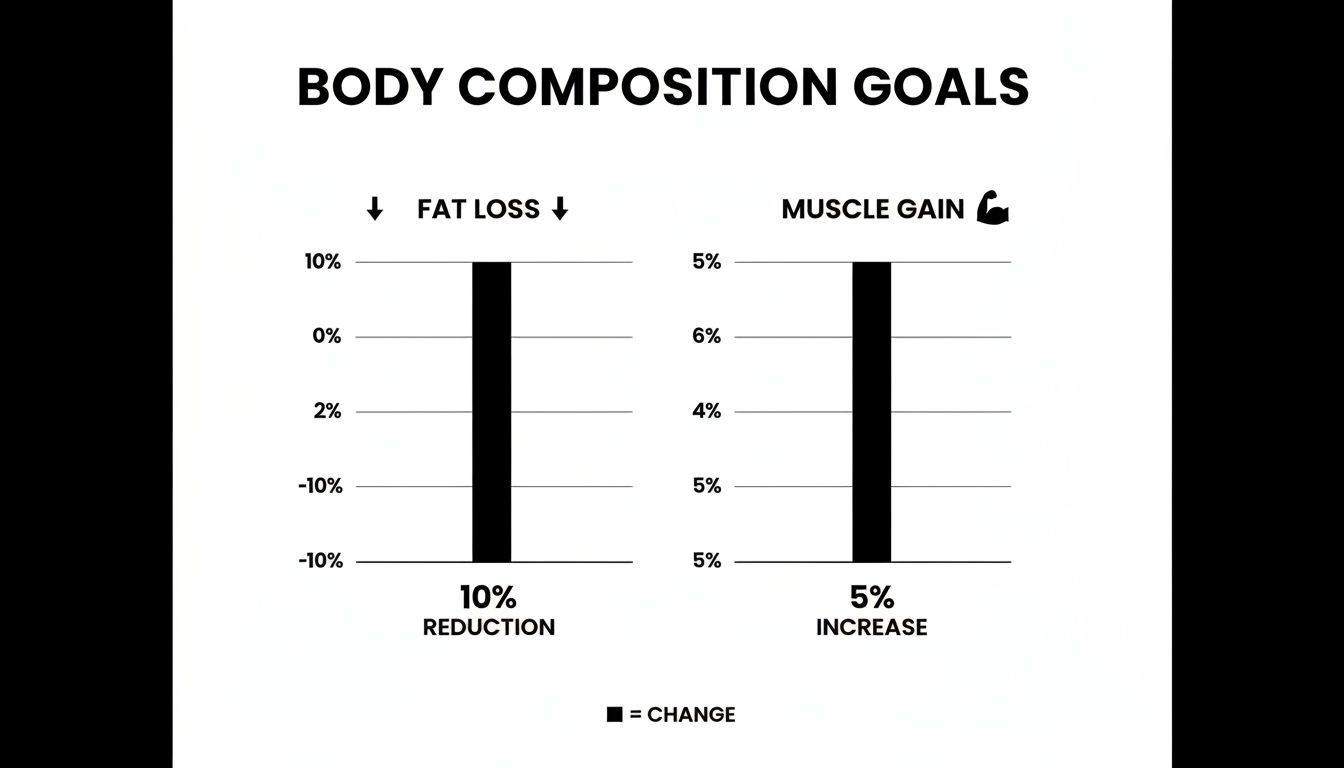
The focus shifts from simply shrinking to strategically losing fat while building lean tissue.
The Proof Is in the Science
A compelling study was published in the journal Obesity. It looked at what happens when people combine dieting with different types of exercise. The results speak for themselves. Total weight loss might be similar across different methods. But the quality of that loss is what matters most.
Here's a breakdown of what that research found:
Comparing Body Composition Changes from Different Exercise Methods
| Metric | Strength Training Group | Aerobics-Only Group | No-Exercise Group |
|---|---|---|---|
| Total Weight Loss | 21 pounds | 22 pounds | 15 pounds |
| Fat Loss | 21 pounds (100% of loss) | 16 pounds (73% of loss) | 10 pounds (67% of loss) |
| Muscle Loss | 0 pounds (muscle preserved) | 6 pounds (27% of loss) | 5 pounds (33% of loss) |
As you can see, the lifting group lost as much weight as the aerobics group. But 100% of it was fat. The other groups lost a significant amount of metabolically active muscle. This set them up for a rebound.
This evidence confirms it. If you want to lose fat and keep it off, strength training is the most reliable path. Looking for what is the best night drink to lose weight? It’s the key to ensuring the weight you lose is the weight you actually want to lose.
Building Your Foundational Workout Program
When you start a strength training program for fat loss, the best foundation is a simple one. It's easy to get bogged down by conflicting information. But the secret is focusing on a few core principles. These give you the most bang for your buck. Consistency and good form will always trump lifting the heaviest weight.
This approach helps you build a solid base. It keeps you safe from injury. And it delivers the kind of steady progress that fuels motivation. Let's forget about overly complex routines and focus on mastering the basics first.

How Often Should You Be Lifting?
As a beginner, your body needs time to adapt and recover. Overtraining is a huge mistake people make right out of the gate. This almost always leads to burnout or injury. That just stalls your progress completely.
For this reason, a full-body workout performed 2-3 times per week is the perfect starting point.
This schedule lets you stimulate every major muscle group multiple times a week. This is a fantastic recipe for muscle growth and calorie burn. It also forces you to take crucial recovery days. This is when your muscles actually rebuild and get stronger. A simple Monday, Wednesday, and Friday schedule works beautifully. It gives you a full day of rest between sessions.
Focus on Compound Exercises for Maximum Impact
If you want to build strength and burn fat efficiently, you have to prioritize compound exercises. These are the big, multi-joint movements that work several muscle groups at once. Think of them as the MVPs of your workout.
Instead of isolating one small muscle at a time, compound lifts place a higher metabolic demand on your body. In practical terms, that means you torch more calories during and after your workout.
These are the foundational movements you should build your entire program around:
- Squats: The undisputed king for working your quads, hamstrings, glutes, and core.
- Deadlifts: A true total-body movement that builds a powerful back, glutes, and hamstrings.
- Overhead Press: The key to building strong shoulders, triceps, and rock-solid core stability.
- Bench Press: Your classic upper-body builder for the chest, shoulders, and triceps.
- Rows: Absolutely essential for developing a strong back and biceps, improving your posture.
By centering your workouts on these core lifts, you guarantee you're hitting your entire body effectively. You can also explore how certain supplements might support this style of training. Learn more in our deep dive on creatine monohydrate vs creatine HCL.
Remember: The name of the game is getting progressively stronger at these fundamental movements. That progress is the clearest sign that you're building lean muscle and changing your body composition.
Your Guide to Sets and Reps
So, you know what to do, but how much of it should you do? This is where "sets" and "reps" come in. A rep (repetition) is one completion of an exercise (like one squat). A set is a group of those reps done back-to-back.
For both building muscle (hypertrophy) and losing fat, the 8-12 rep range is a fantastic target. It’s the sweet spot. It is heavy enough to challenge your muscles to grow. But it has enough volume to seriously crank up your calorie burn.
Here’s what that looks like as a simple, actionable blueprint for your week:
| Component | Recommendation |
|---|---|
| Frequency | 2-3 non-consecutive days per week (e.g., Mon/Wed/Fri) |
| Exercises | 4-5 compound movements per session |
| Sets per Exercise | 3-4 sets |
| Reps per Set | 8-12 repetitions |
| Rest Between Sets | 60-90 seconds |
This structure gives you a clear plan to follow. For example, on squats, you’d perform a set of 8-12 reps. Rest for 60-90 seconds. Then repeat that for a total of 3 or 4 sets before moving on. This is the kind of straightforward framework that gets real, lasting results.
How to Eat for Fat Loss and Muscle Gain
Let's be clear: you simply cannot out-train a bad diet. Your work in the gym signals your body to change. But your nutrition is what actually fuels that transformation. The food you eat provides energy for your workouts. It also provides the building blocks to repair and grow stronger muscle.
This isn’t about crazy restrictions. It is not about living off boiled chicken and broccoli. It’s about being smart with your fuel to achieve a specific goal. You want to shed fat while holding onto metabolically active muscle. And the entire process starts with calories.

The Smart Way to Approach a Calorie Deficit
To lose fat, you have to be in a calorie deficit. That just means you're consuming fewer calories than your body is burning. Simple, right? But here’s where so many people go wrong. They slash calories too aggressively. A massive deficit can flip your body's "starvation" switch. This causes it to break down precious muscle for energy. This is the exact opposite of what we want.
The sweet spot is a small, manageable deficit of around 300-500 calories below your maintenance level each day.
This modest drop is enough to trigger consistent fat loss. It won't sabotage your muscle mass or tank your energy levels. It also helps you avoid the metabolic slowdown from crash dieting. If you're not sure where to start, you can figure out your baseline with our guide on how to calculate your daily calorie needs.
Make Protein Your Top Priority
When you're eating in a deficit, protein becomes your absolute best friend. Think of it as an insurance policy against muscle loss. It provides the essential amino acids your body needs. These repair the muscle fibers you break down during training.
But that's not all. Protein has a few other superpowers:
- It keeps you full. Protein is the most satiating macronutrient. This makes sticking to your calorie goal a whole lot easier.
- It revs your metabolism. Your body burns more calories digesting protein than carbs or fats. This is known as the thermic effect of food (TEF).
A great target for anyone lifting weights is 1.6 to 2.2 grams of protein per kilogram of body weight. That is about 0.7 to 1.0 grams per pound. For a 150-pound (68kg) person, that’s about 109-150 grams of protein per day. Load up on lean sources like chicken breast, fish, Greek yogurt, eggs, and legumes.
This one-two punch of lifting weights and a high-protein, calorie-controlled diet isn't just theory. It's the most effective, scientifically-backed way to truly change your body composition.
The evidence is overwhelming. A massive meta-analysis of 114 studies concluded that combining resistance training with a calorie deficit was the superior strategy. Participants saw a 3.8% reduction in body fat percentage. They lost an average of 5.3 kilograms (nearly 12 pounds) of fat mass. They did all this while preserving their lean muscle. You can read more about how resistance training impacts fat loss in the full study.
Don’t Fear Carbs and Fats
While protein is the star, carbohydrates and fats play critical supporting roles. Trying to cut either of them out completely is a surefire way to feel terrible. This will kill your progress.
Carbohydrates are your body's high-octane fuel source. They power you through intense lifting sessions. This is essential for progressive overload. Skimp on carbs, and your gym performance will nose-dive. Stick to smart choices like oats, brown rice, quinoa, potatoes, and fruit.
Healthy fats are non-negotiable for hormone production. These hormones are vital for muscle growth and overall well-being. They also help your body absorb certain vitamins. Get them from quality sources like avocado, nuts, seeds, and olive oil.
Simple Meal Ideas to Get You Started
Putting this all together doesn't require a culinary degree. Here are a few simple, balanced meal ideas. They will support both fat loss and muscle gain:
| Meal | Example |
|---|---|
| Breakfast | Greek yogurt topped with fresh berries and a handful of almonds. |
| Lunch | A big salad with grilled chicken breast, mixed greens, quinoa, and a light vinaigrette. |
| Dinner | Baked salmon served with roasted sweet potatoes and a side of steamed broccoli. |
| Snack | A quality protein shake or a couple of hard-boiled eggs with an apple. |
The real secret is consistency. Plan your meals ahead of time. Focus on whole, nutrient-dense foods. You'll create the perfect environment for your body to burn fat and build strength.
Actionable Workout Routines You Can Start Today
Knowing the why is one thing. But having a concrete plan is where the real change happens. Let’s get into the nitty-gritty. We will lay out a clear blueprint. You can walk into the gym knowing exactly what to do.
We'll break down two proven routines. One is for beginners. The other is for those ready to step it up a notch. These are built around the big, effective compound movements we talked about. This ensures every minute of your workout is pushing you closer to your goal.
For Beginners: The Full-Body Foundation
If you’re just starting out, a full-body routine is your best friend. The name of the game here is consistency. Learn the movements perfectly. Don't worry about lifting a ton of weight yet. Focus on building a rock-solid foundation.
Aim to hit this workout three times a week on non-consecutive days. Think Monday, Wednesday, and Friday. This schedule gives your body the downtime it needs to recover and build muscle. Pay close attention to your form. Really feel the muscles you’re supposed to be working.
Here’s a simple, powerful routine to get you started.
Beginner Full-Body Workout Routine (3 Days Per Week)
This table outlines a balanced workout that hits all your major muscle groups. The key is to pick a weight that feels challenging by the last couple of reps. But it should still allow you to maintain perfect form.
| Exercise | Sets | Reps | Rest |
|---|---|---|---|
| Goblet Squats | 3 | 8-12 | 60-90 seconds |
| Dumbbell Bench Press | 3 | 8-12 | 60-90 seconds |
| Dumbbell Rows | 3 | 8-12 per arm | 60-90 seconds |
| Dumbbell Overhead Press | 3 | 8-12 | 60-90 seconds |
| Dumbbell Lunges | 3 | 10-12 per leg | 60 seconds |
| Plank | 3 | Hold for 30-60 seconds | 60 seconds |
Remember, if you can easily do more reps, it's time to increase the weight slightly. If you're looking for more ways to use basic equipment, check out these 12 effective weight bench workouts for extra variety.
For Intermediates: The Upper/Lower Split
After a solid 6-8 months of consistent training, you might be ready for a bigger challenge. This is where an upper/lower split comes in. By dedicating entire workouts to your upper or lower body, you can increase training volume. It is a classic method for smashing through plateaus.
This approach usually involves training four days a week. A popular schedule is Monday (Upper), Tuesday (Lower), Thursday (Upper), and Friday (Lower). This gives you a nice recovery day mid-week.
An upper/lower split is a staple in strength programming for one simple reason: it works. Hitting each muscle group with more focused volume is a powerful stimulus for continued growth.
Here’s what a week could look like:
- Upper Body A: Bench Press (3 sets of 6-8 reps), Barbell Rows (3×6-8), Incline Dumbbell Press (3×10-12), Lat Pulldowns (3×10-12), Lateral Raises (3×12-15), Tricep Pushdowns (3×12-15).
- Lower Body A: Barbell Back Squats (3 sets of 6-8 reps), Romanian Deadlifts (3×8-10), Leg Press (3×10-12), Leg Curls (3×12-15), Calf Raises (4×15-20).
- Upper Body B: Overhead Press (3 sets of 6-8 reps), Pull-Ups (3xAMRAP – As Many Reps As Possible), Dumbbell Rows (3×8-10), Dumbbell Bench Press (3×10-12), Face Pulls (3×15-20), Bicep Curls (3×12-15).
- Lower Body B: Deadlifts (3 sets of 5-6 reps), Dumbbell Lunges (3×10-12 per leg), Leg Extensions (3×12-15), Glute Ham Raises (3×10-12), Seated Calf Raises (4×15-20).
As you start lifting heavier, a secure grip becomes non-negotiable. Finding the best liquid chalk for weightlifting can make a huge difference. It is especially helpful on deadlifts and rows. It allows you to move challenging weight with confidence.
How to Consistently Make Progress and Avoid Plateaus
The secret to long-term success with strength training for weight loss is understanding one simple truth. Your body is an adaptation machine. It gets really good, really fast, at handling whatever you throw at it. To keep the fat loss and muscle-building process moving, you have to give it a new reason to change.
That’s where the principle of progressive overload comes into play. It’s the cornerstone of any effective training program. And it’s not as complicated as it sounds. All it means is that you’re gradually increasing the demand on your muscles over time. If you don’t, your body has no incentive to keep improving. You will hit that frustrating plateau we all want to avoid.
Think about it this way. The first time you do a new, hard workout, you’re sore for days. But after a few weeks of the same routine, it feels much easier. To keep getting better, you have to make it challenging again. That's progressive overload in a nutshell.
Simple Ways to Apply Progressive Overload
Making progress isn’t always about adding another 45-pound plate to the bar. Lifting heavier is the most obvious method, but it's not the only one. In fact, cycling through different ways of challenging yourself is a smarter way to make steady gains.
Here are a few of the most effective strategies I use with clients:
- Add More Weight: The classic approach. If you hit your target 3 sets of 10 reps on squats with 100 pounds, try for 105. Even a tiny jump of 2.5 or 5 pounds is a win.
- Do More Reps: Can't quite make the jump in weight yet? No problem. Stick with the same weight but push for one or two more reps. If you did 10 reps, go for 11.
- Add Another Set: Another great way to increase total workout volume is to simply add another set. If you've been doing 3 sets of an exercise, bumping it up to 4 will create a new challenge.
- Shorten Your Rest: Want to ramp up the intensity and metabolic demand? Try cutting your rest periods. If you usually rest for 90 seconds between sets, trim it down to 75.
The key is to always be aiming for a little bit better than last time. This is why tracking your workouts is so important. A simple notebook or an app on your phone becomes your roadmap. It tells you what you need to beat from your last session.
The Critical Role of Recovery
What you do outside the gym is just as important as what you do inside it. Pushing yourself with progressive overload is only half the battle. Your muscles don't get stronger while you're lifting. They repair and grow during the hours and days after your workout.
Skipping rest is the fastest way to burn out. You will feel perpetually sore and set yourself up for an injury.
Rest days are non-negotiable. This is when the real magic happens. Your body repairs the tiny tears in your muscle fibers, rebuilding them stronger. For full-body routines, take at least one full day off between sessions.
And don't forget your number one recovery tool: sleep. Your body releases crucial hormones for muscle repair and fat metabolism during deep sleep. Making 7-9 hours of quality sleep a priority will dramatically improve your results. It will also boost your energy. If you feel like you've hit a wall, learning how to overcome a weight loss plateau often starts with getting serious about your recovery.
Measuring What Matters Beyond the Scale
When you start strength training to lose fat, the scale quickly becomes your least reliable friend. It's a tricky little liar. Why? Because you're doing two things at once. You are building lean, dense muscle and dropping body fat. This fantastic process is called body recomposition. It can make that number on the scale do some very confusing things.
Here's the deal: muscle is much denser than fat. A pound of muscle takes up significantly less space than a pound of fat. So, it's possible for the scale to not budge. It might even go up a bit. This can happen while your waist is shrinking and you're looking leaner. If you only look at your total body weight, you're going to get discouraged.
Trust me, your efforts are working. You just need to start tracking the right things.
Shifting Focus to Performance Metrics
Your performance in the gym is one of the most honest measures of progress. Are you getting stronger? That's a huge, undeniable sign you're building muscle. And muscle is the engine that drives your metabolism and burns fat.
This doesn't have to be complicated. Just keep a simple training log in a notebook or an app. Jot down these key details:
- Lifting Heavier: If you squatted 100 pounds for 10 reps last week and hit 105 pounds this week, that's a win. You're making real, tangible progress.
- Getting More Reps: Maybe you lifted the same weight. But you managed to squeeze out an extra rep or two. That’s your strength and endurance improving right there.
- Nailing Your Form: Sometimes progress isn't about more weight or reps. It is about how you lift. Completing a set with crisp, controlled technique shows you're building stability.
Every time you see one of these numbers improve, it's direct proof that your body is adapting. Each extra pound on the bar is evidence that you're building the lean tissue. This will accelerate your fat loss.
Using Visual and Physical Feedback
Beyond what you can lift, your own body provides the most powerful proof. These methods paint a far more accurate picture of your transformation than the scale.
First, take progress photos. Every four weeks or so, snap a few pictures from the front, side, and back. Try to wear the same thing and stand in a spot with similar lighting. When you put these photos side-by-side, you’ll see the changes. You may see a tighter waistline, more defined shoulders, or firmer legs. It can be a real eye-opener.
A simple tape measure is another fantastic tool. Once a month, take a few key measurements and write them down:
- Waist (around your belly button)
- Hips (at the widest point)
- Thighs (midway up)
- Arms (mid-bicep)
Watching these numbers go down is incredibly motivating. This is especially true when the scale is being stubborn. And finally, just notice how your clothes fit. That pair of jeans that used to be uncomfortably snug? When they slide on easily, that's a real-world victory.
The key to staying motivated is to focus on how you look, feel, and perform. The scale just measures your relationship with gravity; these methods measure actual progress.
The Science of Body Composition
This idea of looking beyond total weight isn't just motivational fluff. It's backed by solid science. For years, conventional wisdom said cardio was the only way to lose fat. We know better now. A major review by researchers at UNSW found that people can lose about 1.4 percent of their total body fat. This is through strength training alone. The result is right on par with what you'd expect from cardio or aerobics.
The crucial difference? With strength training, you build muscle while you lose fat. This is precisely why the scale can be so misleading. You can read the full findings on strength training and fat burn here for yourself.
This research drives home the point. Your body fat percentage, not just your weight, is a far more accurate and empowering way to view your success. By embracing better metrics, you align your tracking with the true goal. The goal is building a stronger, leaner, and more capable version of yourself.
You may also find this Nutrition Geeks guide helpful: Unlock Your Vitality: The Power of Herbal Life Energy Tea.
You may also find this Nutrition Geeks guide helpful: Can You Buy Herbalife in Stores? Your Guide to Finding Products.
You may also find this Nutrition Geeks guide helpful: Master How to Stay Consistent with Exercise & Reach Your Goals.